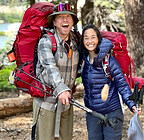
Savannah always wanted to teach yoga, and during my first years of knowing her it was just that: a distant want. But then she found a way to train and get certified as an instructor, and now she teaches at a local gym and a cancer center. I’ll start at the beginning. I met Savannah a decade ago when she came breezing into my office, pure elegance with her long, blonde hair and linen pants, looking for writing assignments. She was getting her MFA in creative writing in Idaho, and somehow I’d been bestowed the title of managing editor at Big Sky Journal. I gave her an assignment, and from there we ended up in a writer’s group together, became running partners, witnessed each others’ life transitions with work, relationships, etc.
In a sense, Savannah is my serious friend. It’s not that we don’t do silly together (she is the one who coined me Eunice, after all); it’s more that we don’t waste time. Lately that means we walk Peets Hill together with our dogs at dusk, and I give her my internal sludge, and she trusts me with hers as well.
Here’s a true story about my decade of friendship with Savannah: We spent one of those years not speaking. For my part, I have cowardly, conflict-adverse tendencies (unless it involves my offspring!) that make me more comfortable fleeing tense situations than working through them. So somehow it took us a year to tiptoe our way back to each other.
Because I spent much of my growing-up years moving every few years, I’ve never had a “lifelong” close friend. So perhaps I’d never been friends with anyone long enough before to realize that hey, if you spend enough time with someone, eventually there will come a time when you’ll disagree, annoy each other, or want to smack that person upside the head. With family, you power through these things, roll your eyes, yell if you must, and life goes on. So in some ways, with Savannah, I’m learning what long-term friendship means.
Here are some current facts about Savannah: she has a job she doesn’t love but pays the bills; she pads those hours with things she does love like teaching yoga to cancer patients; walking, hiking and running with her dog; working as a hospice volunteer; and making plans to go to acupuncture school. (Past fact: She gave Oldest Son his first car, her Toyota Camry, in exchange for him doing community service.)
Also! She is to be credited for introducing me to Shawn. She and Shawn had never met before, but that didn’t stop her from walking over to Shawn — after I revealed to her that I had my eye on him — and insisting he sit next to me during a slide show. When I dropped her off after the slide show that night she said, “I want to be a bridesmaid at your wedding,” before closing the car door.
Savannah always has a poem if you need one. So of course when Shawn and I actually did get married, she stood in front of our family and friends and filled our heads with lovely verses.

Q & A:
What are some things you still want in life that you don’t yet have?
Build a doggie hospice, write for Yoga Journal and Runner's World, start a yoga nonprofit, live off the grid, write novels, make art, practice apitherapy on people besides myself, tend beehives, raise chickens, establish a bigger patch of raspberries and an indoor hydroponic system for blueberries, create a beautifully blooming yard and tree and rock sanctuary, go to acupuncture school, add 500-hour integrative yoga therapist to my current training, and become a death doula (thanks for making up that phrase, Meg).
Savannah's current dog Sasha (front) with some pals up on Ramshorn Peak, MT.
As an avid dog lover, tell us about the first dog you ever loved. (How you met, how long he lived, his spirit, etc.)
Satchmo, Homer, Alaska, 1989, in a trash can outside a grocery store with a big red bow on his head, about four months old, just enough out of his puffy fur-ball stage to apparently not be a purebred Samoyed, but a mix, most likely with Golden Retriever. Saddest thing you ever saw: a depressed puppy. Poor little guy had already been beaten: raise your hand to adjust your hat, say, and watch him cower and hug the ground, tail tucked. Soundless. Ironically, the dog I have now was also a throwaway, four months old when I got her, and had been beaten.
Satchmo lived to be 18. At one point, for an article about running with dogs, I figured we'd traveled by foot over 30,000 miles together — and that's before he was 14. He chose to quit running after that, although he was ambulatory until his dying day.
Satchmo's spirit was peace. Over his life we would many times encounter people who Hated Dogs, and he’d win them over. He didn't jump up, didn't lick, didn't chase cats, didn't do any of those things that give dogs a bad reputation. It takes a LOT of time and presence to achieve rapport with your dog — especially if they are already a wreck when they come to you.
What was it like going to Alaska as an adventurous 20-something and finding yourself right in the epicenter of the Exxon Valdez oil spill?
Life changing. I still refuse to buy gas at Exxon. On the one hand, yeah, as if I'm hurting their profit margin. On the other hand, as Margaret Mead says, never underestimate the power of an individual to change the world. Our small actions add up.
Mostly I saw how bureaucracy got in the way of a lot of good people simply getting the job done to save wildlife. That lesson has stayed with me as I read through the lines of different reports now.
As a hospice volunteer, what drew you to helping people die in your spare time?
It seems like a natural extension of yoga to me: being present. Just being OK with what is without judgment. Letting go of the past, letting go of ambition, just being.
Death doesn't scare me. It saddens me, mostly because it so saddens those going through it and those left behind. If I can look someone in the eye with love as they go through this transition, I'm grateful for the chance to do that.
It's the most alive that I feel when I am with someone in hospice. Not because "hey, I'm living and you're dying," of course. Because I am of use. Because it is, well, life or death. There are not many precious moments like that, moments that truly matter — or, maybe we don't give many moments that attention.
It's about an opportunity to love. In hospice there is no attachment to the person or family, but there is an opportunity to show up, to love in the absolute sense of the word. It's so simple. Read to people. Listen. Look. Really see who they are, what they need. That's all. There's a great African proverb I read recently: die while you are still alive. Maybe that's what I feel: I want people to feel like they got to be alive and be seen right up until the end.
And selfishly, as a writer, holy smokes! The work is loaded with stories, insights into what we love, fear, regret, what we define ourselves by.
Several years ago you were diagnosed with Multiple Sclerosis. How has this disease changed you, and what can you tell me about your situation that might help me to be a better friend?
Most important for me is to be around people — doctors as well as friends — who believe I can heal. I need friends who can tolerate my gluten-free, dairy-free diet and accept last-minute cancellations when I crash, yet who never don't invite me because I might be too tired or the activity might be more than I can do. It's what we all need: people to give us each day to maybe feel fantastic and be able to say yes, people who give us room to be bigger tomorrow than we were yesterday. Conversely, I actually need people who recognize that I have a disease. Because much of MS is invisible or can be hidden, it's easy to forget the accommodations that are sometimes needed.
How has it changed me? Humbling. I've always been able to will my way through anything before. Broken ankle 10 miles out on a run? No problem! I can walk back on that. Herniated discs? Whatever. I can run through that. With MS I have finally had to face that there are times my spirit just isn't big enough to pick my foot up, literally. I can only imagine what Steven Hawking feels, what Christopher Reeves felt. To be so alive and yet so trapped in the body. It is damning.
It also makes me realize how many promises I've made to God and not kept, how many slights I've made to others and not righted, how little I've done with the gifts I've been given. It's a wake-up call: the clock is ticking. The first thing I did after my diagnosis? Bought a ski pass, my first one. I figure if my legs are going to go, better start learning to ski while I can.
On the upside, MS has given me increased empathy and compassion, increased skill with my yoga students. The big bonus: MS is a lie detector. I can no longer pretend something is OK that isn't.
The guys in my house didn't get an elk this year, so Savannah shared some of hers.
You’ve taken up hunting in the past few years. What has the experience of killing, butchering and eating animals been like for you?
Hunting is taking complete responsibility for what I put into my body, doing the least environmental damage in my eating choices, and giving my body the best fuel that I can. Hunting itself: like painting, you have to truly see, very slowly let the world reveal itself to you, the turn of a leaf, the shade of the light moving against the landscape, the juxtaposition of all of the textures and sounds and living creatures. It's magical to be part of, to have one little role in it. I've never felt small next to the night sky or the ocean or on a mountaintop, but with a gun in my hand, I feel like a speck, one tiny mote trying to feed myself.